

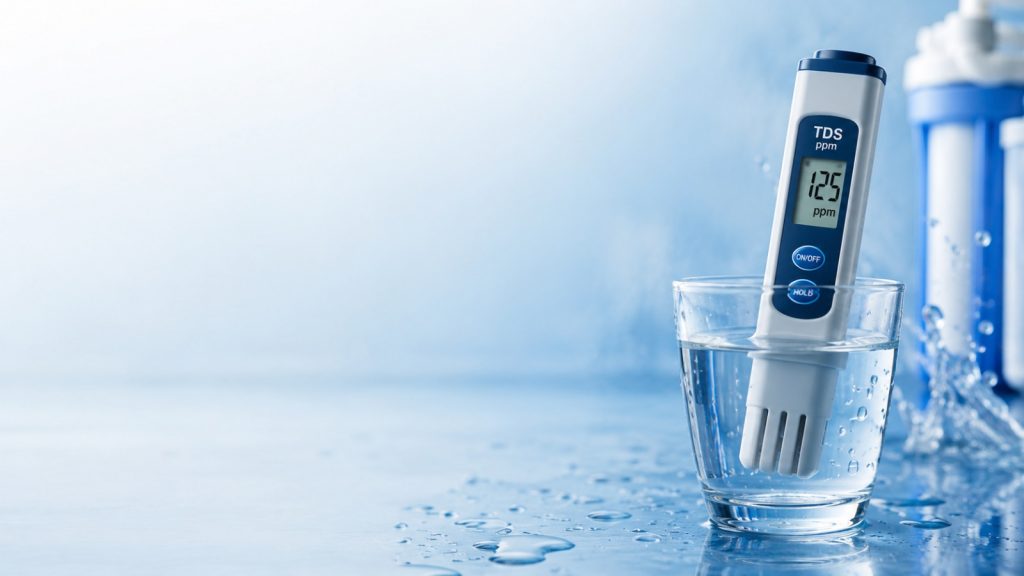
The dissolved salts and minerals in water influence its flavor, corrosion, scaling, as well as the efficiency of operations in industrial and municipal water systems. Understanding TDS water meaning is crucial for appropriate treatment technology choice as well as water quality management.
TDS measurement helps to understand the total amount of dissolved solid substances, which affects water quality for drinking purposes and industrial processes, together with the performance of membrane systems.
Table of Contents
ToggleWhat Is the Full Form of TDS in Water?
TDS is short for Total Dissolved Solids. It represents the total amount of inorganic salts and small amounts of organic matter that can be dissolved in water. The most common dissolved materials are:
- Calcium
- Magnesium
- Sodium
- Chlorides
- Sulfates
- Bicarbonates
Few trace elements and organics
TDS gives an overview of the total ions and dissolved matter present in water, but does not identify single substances.
What Does TDS Indicate About Water Quality?
Total dissolved solids (TDS) means how many dissolved materials there are in the water. High TDS can influence:
- The taste and smell of water
- Scaling
- Corrosion potential
- Membrane and reverse osmosis technology performance
TDS reading provides aggregate readings without giving any specific information on the composition of the dissolved ions.
What Causes High TDS in Water?
The presence of high TDS in the water can be attributed to:
- Natural causes: mineral granitic terrains, natural groundwater, saline aquifers
- Industrial process: effluent discharge, chemical process
- Human activities: urban runoff, return flow irrigation.
The dissolved salts and ions flow through leaching, mixing, and human activity.
How Is TDS in Water Measured?
TDS usually comes in mg/L or ppm. The methods used to determine TDS consist of the following:
- Test water samples in laboratories
- Use conductivity-based TDS meters that calculate TDS based on the electrical conductivity of water.
This method of measurement is efficient and enables one to have a general idea about the level of dissolved solids in a water sample.
What Is a Good TDS Level in Water?
The acceptable levels of TDS vary according to the water source, application, and required output quality as follows:
- Drinking water: 50-500 mg/L, based on taste and regulatory requirements.
- Process water: Optimized according to industrial process needs.
- Boiler water: Low TDS to avoid scaling and corrosion.
- Pharmaceutical and other pure water: Very low, often <10 ppm because of sensitive application.
Effects of High TDS in Water
High levels of TDS may lead to:
- Scaling or deposits build-up in pipes and heat exchangers
- Taste and smell changes
- Industrial operations’ efficiency declines
- Difficulties in operating RO and membrane systems
Therefore, it is essential to control and monitor TDS levels to ensure good water quality, safeguard equipment from damage, and comply with relevant regulations.
How to Reduce TDS in Water?
Dissolved solids removal techniques are as follows:
- Reverse Osmosis (RO): Highly useful for dissolving most salts
- Ion Exchange: Resins for demineralisation applications
- Desalination: Water purification by evaporation-condensation
- Mixing with low TDS water: Utilised in industries
Choosing the appropriate technique is based on water quality and purity.
How Does Reverse Osmosis Remove TDS?
RO applies pressure to run water through a semi-permeable membrane. This process leads to the rejection of dissolved salts, ions, and other impurities, while pure water permeates the membrane surface.
HYDRAMEM RO membranes are used for:
- Drinking water purification
- Brackish water treatment
- Industrial and process water treatment.
They ensure excellent TDS removal and a long lifetime of the membrane.
TDS vs Hardness: What Is the Difference?
- TDS: Refers to the amount of dissolved substances in a sample of water.
- Hardness: Refers to the concentration of calcium and magnesium.
Hard water contributes to TDS, but there are other salts that impact the quality of water and may cause scaling without being considered hard water.
Why Does TDS Monitoring Matter in Industrial Water Treatment?
Constant monitoring of TDS provides the following advantages:
- Stay in control of the process
- Review the performance of membranes
- Ensure that water is acceptable according to specifications
- Optimum chemical dosage during use in cooling systems, boilers, and water treatment systems
Applications of TDS monitoring include:
- Water for boilers
- Water used in the industrial manufacturing process
- Pure water systems
- Desalination plants
- Treatment of industrial water
Choosing the Right Membrane for High-TDS Water
Membrane selection is defined by:
- The composition and total dissolved solids of the feed water
- Target recovery levels and operating pressure
- Fouling risk
- Permeate quality requirements
Membrane types are:
Correct selection results in the efficient reduction of TDS values, energy saving, and long-lasting efficiency of the implemented system.
HYDRAMEM Membranes for Water Treatment
HYDRAMEM membranes allow:
- Efficient water treatment
- Industrial wastewater treatment
- Desalination of sea and brackish water
- Water for drinking, boilers, and process applications
Proper choice of membranes guarantees effective salt rejection, steadiness of permeate quality, and high efficacy of the system used for different types of water treatment.
Conclusion
TDS full form in water is important for evaluating dissolved solids level, maintaining water quality, and deciding on the necessary treatment technology.
High TDS can impact taste, scaling, and operational efficiency in domestic and industrial environments. Accurate TDS monitoring combined with modern treatment methods such as HYDRAMEM RO ensures that the water meets the quality standards for drinking, industrial, and high-purity applications.
Talk to Ion Exchange professionals about HYDRAMEM RO technology to achieve high-quality water treatments.