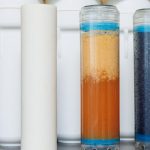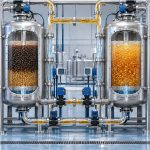


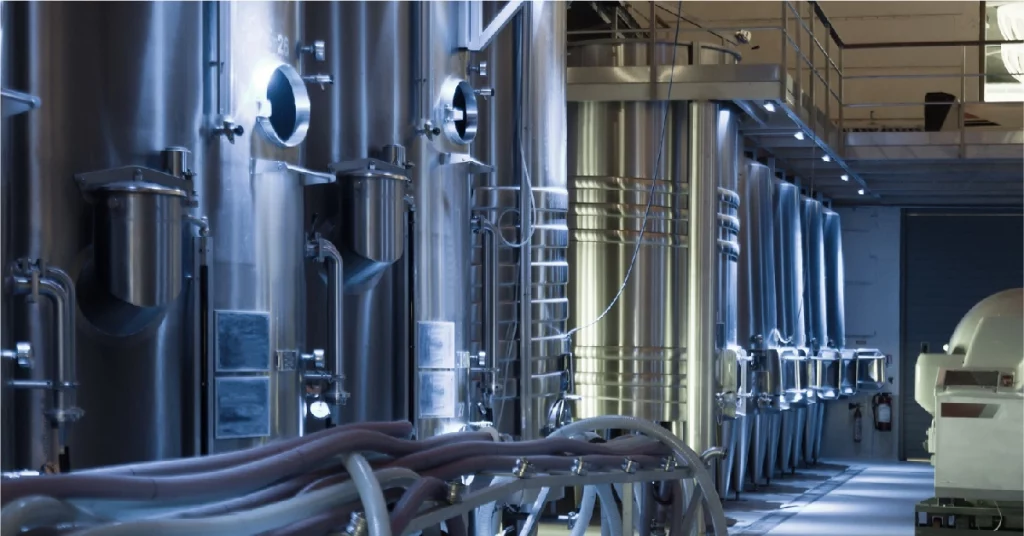
Scaling, hardness, and inconsistent process water quality can affect boilers, heat exchangers, production systems, and downstream water treatment processes. Cation Exchange Resins provide an effective way to remove unwanted positively charged ions and improve water quality for industrial applications.
From water softening and demineralisation to high-purity water production, selecting the right resin chemistry and operating conditions is essential for consistent performance.
With more than 60 years of resin manufacturing expertise, Ion Exchange provides a broad range of ion exchange resins for water treatment and specialised industrial applications.
Table of Contents
ToggleWhat Are Cation Exchange Resins?
Cation exchange resins are synthetic polymer-based materials containing functional groups that exchange positively charged ions, or cations, present in water.
Common cations found in water include:
- Calcium
- Magnesium
- Sodium
- Hydrogen
- Iron and other dissolved metal ions
The resin contains exchange sites that attract and hold these positively charged ions. Depending on the resin’s ionic form and application, unwanted ions can be exchanged with sodium or hydrogen ions.
In simple terms, the resin acts like a selective exchange medium: it captures specific ions from the water and releases another ion in their place.
How Do Cation Exchange Resins Work?
Cation exchange generally takes place through three main stages.
1. Service Cycle
During service, water passes through the resin bed. Unwanted cations are exchanged onto the resin while the corresponding ions from the resin are released into the treated water.
For water softening, calcium and magnesium ions are typically exchanged with sodium ions.
For demineralisation, hydrogen-form cation resins exchange hydrogen ions for dissolved cations.
2. Resin Exhaustion
Over time, the resin’s available exchange capacity is consumed. As more unwanted ions accumulate on the resin, its ability to continue exchanging ions decreases.
The resin then needs to be regenerated.
3. Regeneration
Regeneration restores the resin’s exchange capacity by passing an appropriate regenerant through the resin bed.
Depending on the resin and process, regenerants can include:
- Sodium chloride (NaCl)
- Hydrochloric acid (HCl)
- Sulphuric acid (H₂SO₄)
After regeneration and rinsing, the resin can return to service.
This ability to regenerate and reuse the resin makes ion exchange suitable for continuous industrial water treatment.
Types of Cation Exchange Resins
Cation exchange resins are available in different chemistries and structures depending on the treatment objective.
- Strong Acid Cation (SAC) Resins
Strong Acid Cation Resins contain strongly acidic functional groups, commonly sulphonic acid groups.
They can operate across a broad pH range and are widely considered for:
- Water softening
- Demineralisation
- Boiler feed-water treatment
- RO pretreatment
- Industrial water purification
Ion Exchange’s INDION cation resin portfolio includes strong acid cation resins for full-range cation exchange duties such as water softening and demineralisation.
For example, INDION 225 Na NS is a strongly acidic cation exchanger based on a cross-linked polystyrene matrix with sulphonic acid functional groups. It is supplied in sodium form for water softening and can also be used as the cation exchanger in a hydrogen cycle for deionisation.
- Weak Acid Cation (WAC) Resins
Weak Acid Cation Resins contain weakly acidic functional groups and are commonly considered for applications involving alkalinity-associated hardness and dealkalisation.
Their suitability depends on factors such as:
- Feed alkalinity
- Feed pH
- Water chemistry
- Process configuration
- Regeneration strategy
Ion Exchange’s resin strategy identifies weak acid cation resins for dealkalisation and hardness associated with alkalinity.
- Gel vs. Macroporous Structure
Cation exchange resins can also differ in their physical matrix structure.
Gel resins have a more homogeneous polymer structure and are widely used for conventional ion exchange applications.
Macroporous or macroreticular resins have a more open pore structure and may be considered where organic loading, fouling, or specific process conditions make this structure advantageous.
The appropriate matrix depends on feed composition, competing ions, organic loading, operating conditions, and the treatment objective.
Key Industrial Applications of Cation Exchange Resins
Cation exchange resins are used across several industrial water treatment applications.
- Boiler Feed Water
Hardness-forming ions can cause scale in boilers and associated equipment. Cation exchange softening helps reduce calcium and magnesium before water enters the boiler system.
- Power Plants
Power and utility systems require controlled water chemistry for boilers, condensate systems, and high-purity water loops. Resin selection depends on feed chemistry, leakage targets, and regeneration requirements.
- Food & Beverage
Cation resins can support water softening and purification where controlled water quality is required for processing and utilities.
- Pharmaceutical Water
Pharmaceutical water systems require carefully controlled water quality. Resin selection must consider the intended application, grade suitability, and applicable documentation requirements.
- Sugar Processing
Ion exchange technologies can support water treatment and specialised separation requirements in sugar processing, depending on the specific process stream.
- Semiconductor Applications
High-purity manufacturing processes require tightly controlled water quality. Ion exchange can form part of demineralisation and polishing systems designed for high-purity water.
How to Select the Right Cation Exchange Resin for Your Process?
Selecting a Demineralization Resin or Water Softening Resin should begin with the feed-water chemistry rather than the resin name alone.
Important factors include:
- Feed Water Quality
Evaluate:
- TDS
- Hardness
- pH
- Temperature
- Iron
- Organic loading
- Competing ions
- Required Outlet Quality
The target water quality determines whether the requirement is softening, dealkalisation, demineralisation, or high-purity polishing.
- Regeneration Requirements
The resin type, ionic form, regeneration chemistry, and operating configuration influence chemical consumption and overall operating requirements.
- Operating Conditions
Flow rate, bed volume, pressure drop, temperature, and service cycle duration should all be considered during selection.
- Fouling Risk
Iron, organics, oxidants, and other contaminants can affect resin performance. Feed-water pretreatment and resin selection should therefore be considered together.
Ion Exchange’s resin selection framework specifically highlights feed composition, competing ions, organic loading, oxidants, temperature, vessel design, regeneration, and regulatory requirements as factors that can change resin suitability.
Resin Regeneration & Maintenance Best Practices
Correct regeneration and maintenance are essential for maintaining resin capacity and service life.
- Monitor Resin Exhaustion
Regeneration should be based on the resin’s operating cycle and treated-water quality rather than an arbitrary schedule.
- Backwash Correctly
Backwashing helps expand and clean the resin bed and supports proper bed preparation before the next service cycle.
- Prevent Chlorine Exposure
Oxidising agents can damage certain resin structures. For example, Ion Exchange’s INDION 225 Na NS documentation states that chlorine should be absent.
- Control Iron and Organic Fouling
Iron and organic contaminants can foul resin and reduce effective exchange performance. Appropriate pretreatment and monitoring can help minimise these risks.
- Prevent Resin Drying
Ion exchange resin should be stored and operated under appropriate moisture conditions. Repeated drying and rewetting can cause physical stress and resin fragmentation.
Why Ion Exchange Global Is a Trusted Cation Exchange Resin Manufacturer?
Ion Exchange has more than 60 years of resin manufacturing expertise and provides a broad portfolio of cation and anion exchange resins for water treatment and specialised industrial applications.
Its resin capabilities cover applications including:
- Water softening
- Demineralisation
- High-purity water
- Selective ion removal
- Industrial process applications
- Specialised resin requirements
Ion Exchange’s resin strategy also highlights strong acid cation and weak acid cation families within its broader INDION® portfolio, with selection based on chemistry, matrix, operating conditions, and application requirements.
The company’s resin expertise is supported by water treatment engineering and lifecycle capabilities, allowing resin selection to be considered as part of the complete Ion Exchange Water Treatment system rather than as an isolated consumable.
Conclusion
The right Cation Exchange Resin can improve water quality, control hardness, support demineralisation, and protect downstream industrial processes.
However, resin selection should always consider feed-water chemistry, resin structure, operating conditions, regeneration requirements, and the required outlet quality.
With more than 60 years of resin manufacturing expertise and a broad INDION® resin portfolio, Ion Exchange can support industries in selecting resin solutions suited to their specific water treatment requirements.
Connect with Ion Exchange experts for cation exchange resin selection, technical specifications, and application-specific ion exchange water treatment solutions.