

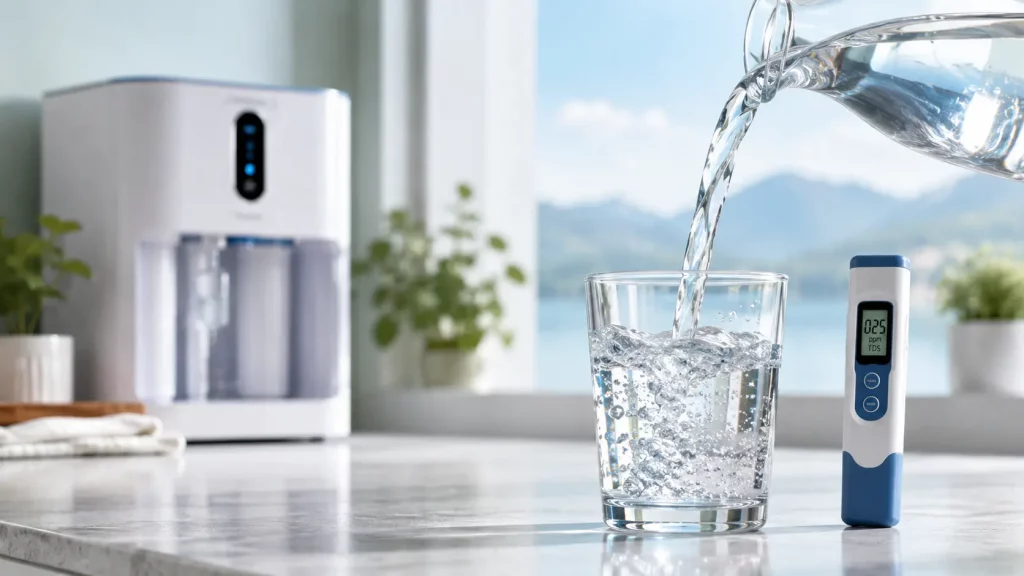
If your water purifier shows a reading of 25 ppm, it is reasonable to ask, is 25 TDS safe for drinking water? TDS measurements that fall in this range typically mean that water contains little in the way of dissolved salts and minerals, something that often occurs as a consequence of passing water through a reverse osmosis system. However, even though news of a TDS reading alone might suggest that water is safe to drink, it would actually not assure, in any way, that water is not contaminated. TDS can only tell about the substances dissolved in water but not of the presence of specific impurities, like bacteria, viruses, pesticides, or heavy metals.
The result is that water-treatment specialists do not rely too much on a TDS reading. It is certainly more important to ask the questions on water composition instead.
Table of Contents
ToggleWhat You Should Know About Drinking Water at 25 TDS
Water with a TDS of 25 mg/L, or approximately 25 ppm, can be suitable for drinking if it meets the required microbiological, chemical and physical drinking-water standards.
A TDS reading of 25 indicates the low concentration of total dissolved solids. However, it does not confirm the microbiological safety of water or specify the harmful substances present.
The World Health Organization does not set a health-based guideline value for TDS since it is not a health concern at the levels generally found in drinking water. Instead, WHO assesses it in terms of water’s acceptability and taste.
So, the technically correct answer to the query of whether 25 TDS is safe for drinking water is yes, but the presence of TDS alone cannot determine its potability.
What Does TDS Mean in Drinking Water?
TDS stands for Total Dissolved Solids. It refers to dissolved inorganic salts and small quantities of organic matter present in water.
Common dissolved substances encompass calcium, magnesium, sodium, potassium, carbonate, chloride, and sulfate. The specific nature of the substances depends heavily on the source of the water, the local geologic features, the human activity and the treatment procedures.
A TDS meter is a good method to find out the concentration of dissolved ions, but the TDS value does not show what substances are actually present.
For example, two water samples may have the same TDS value for drinking water while being totally different in their chemical compositions.
Similarly, a low reading cannot confirm the absence of:
- Disease-causing microorganisms
- Arsenic, lead or other specific contaminants
- Nitrates
- Pesticide residues
- Organic contaminants
- Other substances controlled under drinking-water standards
TDS should therefore be treated as one water-quality indicator, not as a complete water-quality report.
Is 25 TDS Safe for Drinking Water After Purification?
A TDS of around 25 ppm is often associated with highly purified or RO-treated water because reverse osmosis membranes reduce a substantial proportion of dissolved ions.
Consider a common household situation. Someone tests the outlet of an RO purifier and gets a reading of 25 ppm. The immediate reaction may be: “Is this too low?”
That is not necessarily the right question.
A better assessment would look at the incoming water quality, the contaminants the treatment system was designed to remove, membrane performance, disinfection, storage conditions and the quality of the final treated water.
Low mineral content by itself does not establish that the water is unsafe. At the same time, low tds water should not automatically be assumed safe simply because the meter displays a small number.
This distinction matters particularly where groundwater, tanker water, borewell water or other variable sources are being treated. Source-water characteristics can change, and different contaminants require different treatment approaches.
What Is the Ideal TDS for Drinking Water?
People often search for the ideal tds for drinking water expecting one universally correct number. In practice, drinking-water quality cannot be reduced to a single TDS target.
For India, IS 10500:2012 specifies 500 mg/L as the acceptable limit for total dissolved solids and 2,000 mg/L as the permissible limit in the absence of an alternate source. These figures need to be interpreted as part of the complete drinking-water specification, not as standalone proof of safety.
A practical way to interpret TDS is:
| Situation | What the TDS reading tells you |
| Very low TDS | Water contains relatively few dissolved ionic substances |
| Moderate TDS | Water contains a greater concentration of dissolved salts and minerals |
| Higher TDS | Further investigation may be needed for acceptability, scaling potential, source-water characteristics or treatment requirements |
| Any TDS level | Additional microbiological and chemical testing may still be necessary |
Therefore, the ideal tds for drinking water is better understood within the context of source-water chemistry, treatment objectives, taste, regulatory requirements, and overall water quality.
What Is the Minimum TDS for Drinking Water?
There is considerable confusion around the minimum tds for drinking water.
A low reading is sometimes interpreted as automatically unhealthy because fewer dissolved minerals remain in the water. That conclusion is too simplistic.
TDS standards generally focus on controlling excessive dissolved solids and assessing acceptability. They should not be interpreted as defining a universal minimum concentration that water must contain before it becomes safe to drink.
WHO’s drinking-water guidance does not establish a health-based TDS guideline value.
More importantly, the minerals present in water are only one part of the overall assessment. When evaluating a supposed minimum tds for drinking water, professionals also consider microbiological quality, individual chemical parameters, pH, source conditions, and treatment performance.
A number on a handheld TDS meter cannot replace laboratory water-quality testing.
Is Low TDS Water Safe to Drink?
Low tds water can be suitable for drinking when it meets the relevant potable-water requirements.
Low total dissolved solids is most frequently a condition that occurs in water that has undergone treatment processes such as reverse osmosis and demineralization that result in the removal of dissolved salts; however, as advancements in technology allow for continuous improvement in processes such as ion exchange that also use various techniques like reverse osmosis, ultrafiltration, and chlorine treatment, among various others.
The treatment process is also important.
For example, water may have low TDS levels but be contaminated with microorganisms due to poor storage.
On the other hand, more TDS might not be an issue if parameters are within the allowable limits as well.
What Should the TDS Level for Drinking Water Be After RO?
There is no universally correct ro water tds level for every water source and every treatment system.
RO performance depends on the quality of feed water, membrane characteristics, operating conditions, system recovery, pretreatment, and the desired quality of the finished water.
For example, a facility treating brackish groundwater has a different treatment challenge from one processing relatively low-TDS municipal water.
A suitable ro water tds level therefore has to be evaluated together with:
- Feed-water analysis
- Target water-quality requirements
- Contaminants that need to be controlled
- RO membrane performance
- Post-treatment requirements
- Disinfection and storage conditions
Where needed, post-treatment or mineral adjustment may also form part of the overall treatment design. The objective should be appropriate finished-water quality, not simply the lowest TDS reading achievable.
So if your purifier produces 25 ppm and you are wondering is 25 tds safe for drinking water, look beyond the display. Review the source-water quality and, where there is uncertainty, have the treated water tested for the relevant drinking-water parameters.
What Else Should Be Checked Besides TDS?
A reliable drinking-water assessment considers several parameter groups.
Microbiological testing can determine whether organisms such as E. coli or thermotolerant coliform bacteria are present. Chemical testing can evaluate parameters such as fluoride, nitrate, arsenic, iron, chloride and other substances relevant to the source and local drinking-water specification.
Physical and organoleptic characteristics such as turbidity, colour, odour and taste may also require evaluation.
IS 10500 itself covers TDS alongside microbiological, physical and numerous chemical parameters, illustrating why no single measurement should be used as a substitute for a complete assessment.
If the water source changes noticeably, treatment performance falls, taste or odour changes, or there is uncertainty about contamination, appropriate testing provides far more useful information than repeatedly checking TDS alone.
How Ion Exchange Helps with Water Treatment
Water-treatment design starts with understanding the water, not selecting equipment from a single TDS reading.
Ion Exchange provides treatment solutions for homes, institutions, communities, municipalities, and industrial applications. Its portfolio covers clarification, filtration, disinfection, process-water treatment, reverse osmosis, ultrafiltration and post-treatment technologies designed around different feedwater conditions and treated-water requirements.
Readers evaluating potable-water requirements can review Ion Exchange’s drinking water treatment solutions.
For broader treatment requirements, its water treatment solutions cover raw-water, process-water, and post-treatment applications.
Industrial users assessing membrane-based treatment can also refer to Ion Exchange’s process water treatment solutions, which include reverse osmosis, nanofiltration, ultrafiltration, and other technologies.
The appropriate solution depends on a proper water analysis, operating conditions and the required finished-water quality.
Final Takeaway: Is 25 TDS Safe for Drinking Water?
So, is 25 tds safe for drinking water? A reading of 25 ppm is not automatically a reason for concern, particularly with RO-treated water. It indicates a low concentration of dissolved solids, but it does not establish whether the water is safe or unsafe.
The sensible approach is to assess the complete water quality. TDS, microbiological parameters, specific chemical contaminants, treatment performance, and applicable drinking-water standards should all be considered together.
If you are uncertain about source-water quality, RO performance, or the treatment process required for a residential, commercial, or industrial application, consult a qualified water-treatment professional. Ion Exchange can help assess treatment requirements and identify an appropriate water purification approach based on the actual characteristics of the water.