

Chemical consumption keeps climbing. Regeneration cycles seem to come around sooner. Yet treated-water quality is slowly moving in the wrong direction. For many industrial water treatment plants, the problem is not necessarily the Ion Exchange Resin itself. It often comes down to how the resin is operated and regenerated.
Ion exchange resin regeneration restores an exhausted resin to a usable ionic form so it can continue removing unwanted ions from water. Done correctly, it protects water quality, controls chemical use, and delays costly resin replacement. Done poorly, the same process can waste acid, alkali, salt, rinse water, and operating hours.
So, where should a plant start? The answer lies in treating regeneration as a controlled process rather than a routine chemical cycle.
Table of Contents
ToggleWhat Is Ion Exchange Resin Regeneration?
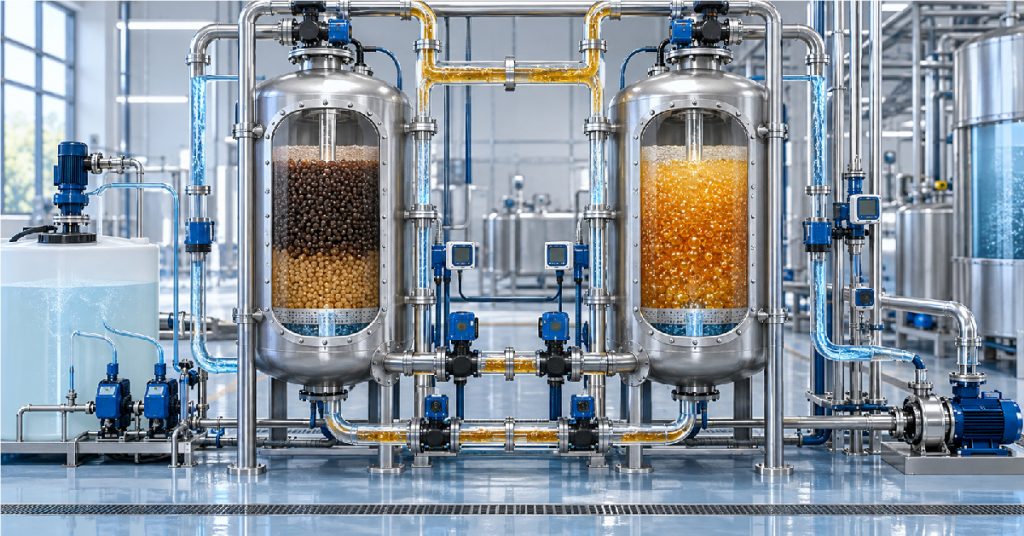
Ion exchange resin regeneration is the process of restoring the exchange capacity of resin after its active sites have become loaded with ions removed from water.
Resin exchanges fundamental ions such as sodium, hydrogen, and hydroxide for the undesired dissolved ions while it works. The performance of the resin begins declining as soon as enough active sites are occupied. Once the saturation level has been reached, a regenerant is passed through the resin bed,d which displaces the ions and restores the resin to its required form. Ion Exchange refers to the process where exhausted resin beads are restored to their original ionic condition by backwashing, injecting a chemical solution and rinsing appropriately.
The following principle is used regardless of whether it is used for water softening, demineralisation, deionisation, condensate polishing or high-purity water.
A wide variety of economical uses of the technology can be found in pharmaceutical production, power generation, process industry and other specific productions where quality is of primary importance.
The firm provides a range of resins used for softening, deionisation, dealkalisation and mixed-bed polishing.
Signs Your Ion Exchange Resin Needs Regeneration
It is rarely a good practice to wait for complete exhaustion levels. Some indications of malfunctioning in a system can occur much sooner.
Signs to check for are:
- An increase in conductivity or TDS levels
- Breakthrough in hardness, silica, or other ions
- A drop in the quality of treated water before the planned end of cycle
- Unusually short periods between regenerations
- Abnormal pressure drop or flow behavior due to fouling or a problem with the bed
All warnings should be taken into account simultaneously. For example, an increase in pressure drop may indicate the loading of suspended solids rather than resin exhaustion, while breakthrough in conductivity may lead to the conclusion about bad regeneration or channelling.
Trend data is therefore more valuable than a single reading.
Step-by-Step Ion Exchange Resin Regeneration Process
A controlled ion exchange resin regeneration process normally follows a sequence designed to prepare the bed, restore active sites, and remove residual chemicals before service resumes.
1. Backwash: The resin bed is washed with water to free it from impurities, fine grit, and shattered beads. A clean and uniformly packed bed will allow the resin to be treated evenly.
2. Chemical regeneration: The appropriate regenerant is introduced at a controlled concentration and flow rate. Uniform distribution matters because channeling can leave part of the bed poorly regenerated.
3. Slow rinse: Water moves through the bed at a lower rate, allowing the regenerant to remain in contact with the resin while displaced ions are removed.
4. Fast rinse: Remaining regenerant and contaminants are flushed out until the required outlet-water quality is achieved.
5. Return to service: Once conductivity, hardness, silica, or other respective parameters fall within the specification, the bed is returned online.
The Ion Exchange guidance on the regeneration process involves the steps of backwashing, chemical dosing, slow rinse and fast rinse, plus post-treatment where required for ultra-pure applications.
Choosing the Right Regeneration Chemicals
The right ion exchange resin regeneration chemicals depend on both resin type and operating form.
| Resin/Application | Common Regenerant |
| Sodium-cycle softening resin | Sodium chloride, NaCl |
| Hydrogen-form cation resin | Hydrochloric acid, HCl, or sulphuric acid, H₂SO₄ |
| Hydroxide-form anion resin | Sodium hydroxide, NaOH |
According to Ion Exchange, cation resins may either be regenerated through the use of salt or by the use of acids, depending on the purpose of the application; however, it has been established that most anion resins are regenerated with the use of caustic soda. The fact that a certain chemical could be the cheapest item on a purchase order does not at all mean that it is also the cheapest option to use that item in practice.
The reason for this is that the wrong chemical concentration, incorrect purity, incorrect dosage, etc., could not only lead to larger rinsing requirements but may also introduce the chances of some materials coming out of precipitation or hindering effective regeneration of the material.
That makes chemical selection an important component of ion exchange resin regeneration cost, not simply a procurement decision.
Optimizing Regenerant Concentration and Contact Time
More chemical does not automatically mean better regeneration.
Each resin is characterized by a specific interval of values that helps to attain the optimum ratio of maximum regeneration efficiency to minimum usage of the reagents. Trying to strive for total regeneration is likely to be very costly in terms of the amount of chemicals.
The ideal objective is not merely some figure but the degree of regeneration ensuring good water treatment without high costs of operations.
Insufficient time for regeneration leads to unsuccessful regeneration of the media bed, while too thorough chemical treatment is a waste of regenerants that will not bring any benefits.
Key Factors That Drive Up Regeneration Costs
Why does one plant use substantially more regenerant than another treating similar water?
Several operating issues can push up ion exchange resin regeneration costs.
- Excessive chemical dosing increases direct chemical expenditure as well as neutralisation and disposal requirements.
- Poor backwashing allows suspended matter and fouling deposits to accumulate, interfering with mass transfer and chemical contact.
- Incorrect resin selection or sizing can shorten service runs and force the plant into more frequent regeneration cycles.
- Poor flow distribution causes channeling, leaving sections of the resin underused or inadequately regenerated.
- Inadequate monitoring means operators often regenerate according to habit instead of actual bed performance.
Ultimately, it is also the system for regeneration that plays a vital role. Counter-current systems are able to provide a higher chemical efficiency and less ionic leakage than a standard co-current system if the apparatus and operation are treated properly. The technology notes that counter-current systems are characterized by lower volumes of the wastewater produced and increased efficiency of the regenerant.
Proven Strategies to Reduce Ion Exchange Resin Regeneration Cost
The strongest savings usually come from several modest improvements working together rather than one dramatic change.
Consider counter-current regeneration where technically suitable. Countercurrent operation helps with the more effective contact of a fresh regenerant with the polishing end of the bed, thus improving the use of regenerant. However, the savings will depend on the type of system, the type of resin being used, and the quality of water that should be obtained; it cannot be assumed without the data obtained from the plant.
Use automated control wherever practical. Use conductivity, hardness, silica, and flow or throughput data to trigger regeneration based on actual exhaustion rather than an arbitrary calendar interval.
Test resin condition regularly. Capacity testing and visual or laboratory examination can identify organic fouling, iron contamination, or bead degradation before the problem results in large chemical losses.
Optimise regenerant strength, temperature and flow for the specific resin. There is no universal “best” temperature or concentration. Resin chemistry, contaminant loading and manufacturer limits should determine the operating window.
Evaluate regenerant recovery where feasible. In suitable applications, recovery or reuse can reduce chemical demand and waste volume, although contaminant concentration and downstream disposal requirements need careful assessment.
Record every regeneration cycle. Track chemical consumption, rinse volume, treated-water output, and breakthrough quality. Cost per cubic metre of acceptable treated water is often more meaningful than chemical consumption alone.
Common Ion Exchange Resin Regeneration Mistakes to Avoid
Some of the most costly complications with resins stem from small operational shortcuts.
If the backwashing is not performed correctly, it may cause a filtration system to be clogged. Poor filtration may also lead to old chemicals being passed down the system. Ignoring the presence of iron and manganese and the possibility of organic pollution will reduce the work capacity of resins with time, and using inappropriate flow rates can contribute to channeling.
Another typical mistake is to apply the same dose of chemicals whenever, no matter what the feed-water quality is like.
Ion Exchange claims that the problems that threaten resin life and efficiency of the regeneration process include exposure to chlorine, accumulation of iron and manganese, organic pollution, incorrect flow rates, low-quality regenerants, and ineffective slow rinsing.
The lesson is simple: standardise the procedure, but do not operate blindly.
When to Replace vs. Regenerate Your Ion Exchange Resin
Regeneration does allow for the restoration of the ability of an exchange medium to do its work; however, there are some forms of degradation that it will not cure. Replacement should be considered when laboratory tests have revealed long-term loss of capacity in a medium that has been regenerated or cleaned properly, when a large percentage of the medium’s beads are broken, or when serious organic or chemical fouling occurs.
There is no single lifespan for every Ion Exchange Resin. Published industry guidance shows that expected life varies materially by resin type and application. DuPont, for example, gives expected lifetimes around six to eight years for several industrial polishing resin categories under defined operating conditions, while Ion Exchange notes that appropriate regeneration and operating practices can extend service life substantially.
Rather than replacing resin purely because of age, assess capacity, bead condition, pressure drop, and treated-water performance.
Industry Trends in Ion Exchange Resin Regeneration: 2025–2026
Resin regeneration has made strides in terms of improved process control, waste reduction, and better utilisation of regenerants.
Automation has played a critical role as it allows plants to improve the timing of regeneration through operational data analysis rather than through fixed schedules. At the same time, research focuses on the study of regenerable resins and formulation of the most effective regenerants for the removal of hard contaminants.
For instance, PFAS is studied in recent research on PFAS-containing anion exchange resins being regenerated multiple times. Earlier, those were considered single-use resins. According to research in 2025, the use of the regeneration process and recovery of regenerant has lowered the cost of PFAS management.
However, the research has gone further in the 2026 project, where machine learning technologies are applied to identify the composition of regenerants and the conditions of PFAS desorption.
It should be noted that not every treatment plant applying PFAS technology requires sophisticated regeneration, but there is a general trend toward the use of more information, more efficient chemicals, and improved waste management in the industry.
How INDION Resins Support Efficient Water Treatment?
Selecting the right resin is the foundation of an efficient resin regeneration process.
ION is a brand by Ion Exchange focused on the production of various types of resins, including gel, macroporous and isoporous cation and anion resins. While this line of products can be applied in water treatment, they also have a number of other applications in different industries, including food and beverage.
Among other areas, INDION products find application in industrial water treatment for the purposes of demineralization, softening, dealkalization, and mixed bed polishing.
The organization’s approach to optimizing the use of its systems by correlating resin chemistry, system design, and regeneration conditions with current water conditions guarantees that plants will not only need to purchase replacement resins but will also manage their lifetime treatment expenses.
Final Thoughts
Optimising Ion Exchange Resin regeneration is not about using more chemical or regenerating more frequently. It is about extracting more useful treated-water capacity from every regeneration cycle.
Start with the fundamentals: correct resin selection, effective backwashing, suitable ion exchange resin regeneration chemicals, controlled contact time, reliable rinsing and performance-based monitoring. Then use operating data to identify where chemicals, rinse water, and resin capacity are being lost.
That disciplined approach can reduce avoidable operating expenditure while protecting treated-water quality and extending useful resin life.
For application-specific product selection, regeneration guidance and technical support, explore high-performance ion exchange resins at ionresins.com.