

For an industrial facility, safe drinking water is more than an employee amenity. It is closely tied to workforce welfare, compliance, operational reliability, and the overall quality standards of the site. Yet selecting an Industrial Drinking Water Treatment solution is rarely as simple as comparing capacities or choosing a purification technology.
A factory may depend on borewell water with high hardness, surface water affected by seasonal turbidity, or municipal supply that changes in quality through the year. The treatment system has to handle these variations consistently without creating excessive chemical consumption, maintenance,e or downtime.
That is why choosing the right manufacturer matters just as much as choosing the right technology. The real question is not, “Which water treatment machine should we buy?” It is, “Who can engineer a system around our actual water conditions and keep it performing reliably?”
Table of Contents
ToggleWhat Should an Industrial Drinking Water Treatment System Deliver?
A well-designed Industrial Drinking Water Treatment system should consistently produce potable water while responding effectively to the characteristics of the incoming water.
In India, potable water quality is commonly assessed against IS 10500 requirements. Ion Exchange notes that drinking water should be clear, free from objectionable colour, taste and odour, and controlled for parameters such as dissolved solids, hardness and pathogenic bacteria.
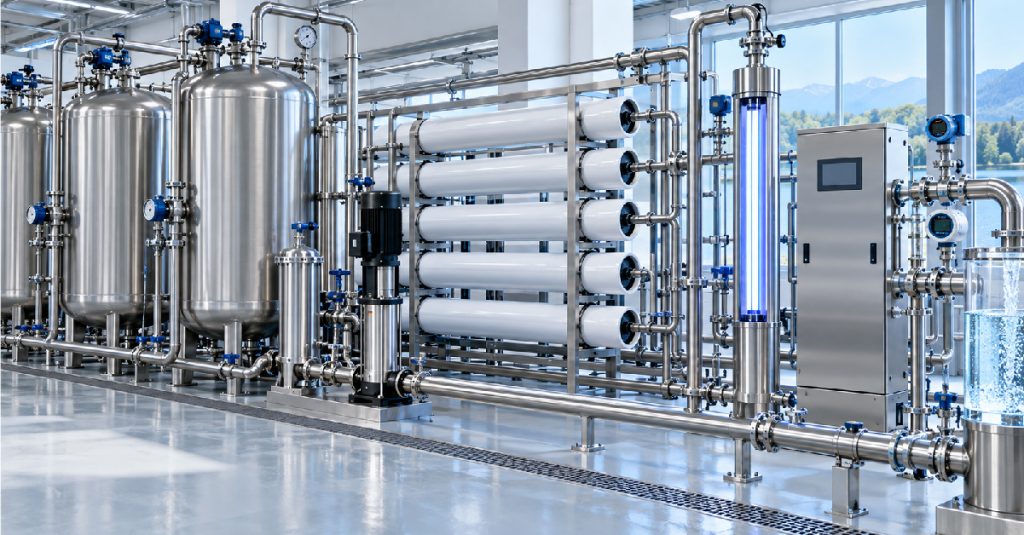
Depending on the water source, a drinking water treatment plant may require clarification, filtration, activated carbon treatment, softening, membrane separation and disinfection. Technologies such as reverse osmosis, ultrafiltration, ozonation, electrochlorination and ion exchange resins can all have a role. Ion Exchange currently uses several of these technologies across its potable-water solutions.
But adding more technology does not automatically create a better plant. Good engineering means using the right processes in the right sequence.
Start With Raw Water Analysis, Not Plant Capacity
One of the easiest mistakes during procurement is starting the discussion with capacity alone: 10 m³/hour, 25 m³/hour, or 50 m³/hour.
Capacity matters, but it does not tell an engineer what needs to be removed from the water.
Before selecting an Industrial Drinking Water Treatment Manufacturer, obtain a detailed raw-water analysis covering relevant physical, chemical and microbiological parameters. The supplier should then be able to explain why every stage of treatment is being proposed.
High turbidity, for example, may require coagulation, clarification and filtration. High hardness could call for softening. Elevated dissolved solids may justify reverse osmosis. Microbiological contamination demands an appropriate disinfection strategy.
Ion Exchange’s raw-water treatment portfolio includes aeration, coagulation and flocculation, clarification, filtration and disinfection to address issues such as suspended solids, iron, bacteria and hardness.
If a supplier recommends a standard system before understanding the feed water, that should raise questions.
Evaluate the Complete Treatment Process
A reliable potable water treatment system should work as one connected process rather than a collection of standalone equipment.
Pretreatment affects membrane performance. Filtration affects downstream equipment. Disinfection affects microbiological safety. Storage and distribution influence the quality of water after treatment. Instrumentation determines how quickly operators can spot a deviation.
Ask potential suppliers to explain the process clearly.
Questions worth asking include:
- What contaminants does each stage remove?
- What treated-water quality can be expected?
- How will the system respond to seasonal changes?
- How will critical water-quality parameters be monitored?
- What happens if raw-water turbidity or TDS suddenly increases?
- What redundancy is provided for critical operations?
This is where an experienced water treatment plant manufacturer should stand apart from a simple equipment vendor. The manufacturer should connect water chemistry, hydraulics, equipment sizing, controls, and operating conditions into one coherent design.
Look Beyond the Initial Plant Price
Procurement teams naturally compare quotations. The problem begins when CAPEX becomes the only deciding factor.
The purchase price represents only one part of the lifecycle cost of an industrial water purification system. Electricity, chemicals, membranes, filter media, cartridges, resin regeneration, spare parts, reject-water generation, and operator involvement can all affect the actual cost of producing potable water.
A cheaper plant that consumes more chemicals or requires frequent membrane replacement may prove expensive within a few years.
Ask manufacturers for expected operating consumption, consumable replacement intervals and preventive-maintenance requirements. It is also worth checking whether equipment has been sensibly sized for actual demand rather than unnecessarily oversized.
A strong supplier should be willing to discuss cost per unit of treated water and total cost of ownership, not only equipment price.
Check Whether the Plant Can Adapt to Future Requirements
Industrial sites rarely remain static.
A facility may expand its workforce, add another production block, shift to a different raw-water source, or face tighter water-quality requirements. A system designed without flexibility can quickly become a bottleneck.
When evaluating your drinking water treatment plant, ask whether capacity can be expanded and whether additional filtration, membranes or disinfection systems can be incorporated later.
Ion Exchange offers both customised and pre-engineered water-treatment plants designed around different applications, quality requirements and variations in feed water.
For some facilities, a modular plant may offer faster installation and easier expansion. Complex industrial campuses, on the other hand, may benefit from a customised engineering approach.
There is no universally correct configuration. The correct configuration is the one built around the site’s present and reasonably foreseeable requirements.
Manufacturing and Service Capability Matter Too
Water treatment equipment operates every day. That makes after-sales support a procurement criterion rather than an optional extra.
Before finalising a water treatment plant manufacturer, review its engineering capability, manufacturing standards, commissioning support, operator training, service network and availability of original consumables and spare parts.
This becomes particularly important when an industrial water purification system includes multiple technologies such as filters, membranes, resins, dosing systems, instrumentation and automation.
Working with one experienced engineering partner can reduce the coordination problems that arise when different suppliers are responsible for separate parts of the plant.
Ion Exchange states that its integrated services cover water-treatment plant performance, while its India operations include service support, operation and maintenance, spares and consumables alongside engineered water and wastewater systems.
Why Consider Ion Exchange for Industrial Drinking Water Treatment?
Ion Exchange has been providing water-treatment solutions for industries, institutions, municipalities and communities for more than six decades. Its wider portfolio covers raw-water treatment, process treatment, post-treatment and drinking-water applications.
Its drinking-water solutions incorporate technologies such as reverse osmosis, ultrafiltration, electrochlorination, ozonation and resins. Its process-water capabilities also include softening, demineralisation, nanofiltration, RO, UF and electrodeionisation.
That broader engineering capability can be valuable for an industrial campus because potable water often forms only one part of its overall water requirement.
A facility may also need an industrial water treatment plant for process applications, boiler feed water, cooling water, wastewater treatment, recycling or Zero Liquid Discharge. Working with a company that understands the entire water cycle can simplify future integration and expansion.
For a new potable water treatment system, the more useful starting point is therefore not a catalogue model. It is an assessment of source-water quality, consumption patterns, available space, required output quality, operating conditions, and lifecycle expectations.
Conclusion: Choose Reliable Water Performance, Not Just Equipment
Selecting an Industrial Drinking Water Treatment solution is ultimately a long-term operational decision. Water quality, employee welfare, maintenance requirements and plant operating costs all depend on how well the system has been designed for the site.
When comparing manufacturers, look beyond capacity and quotation value. Assess treatment logic, engineering expertise, automation, lifecycle costs, service capability,y and the flexibility to accommodate future requirements.
The right Industrial Drinking Water Treatment Manufacturer should be able to explain every technology choice and continue supporting the system well after commissioning.
If your facility is planning a new system or upgrading an existing industrial water treatment plant, connect with Ion Exchange to discuss a water-treatment solution engineered around your actual source water, site requirements, and long-term operating needs.