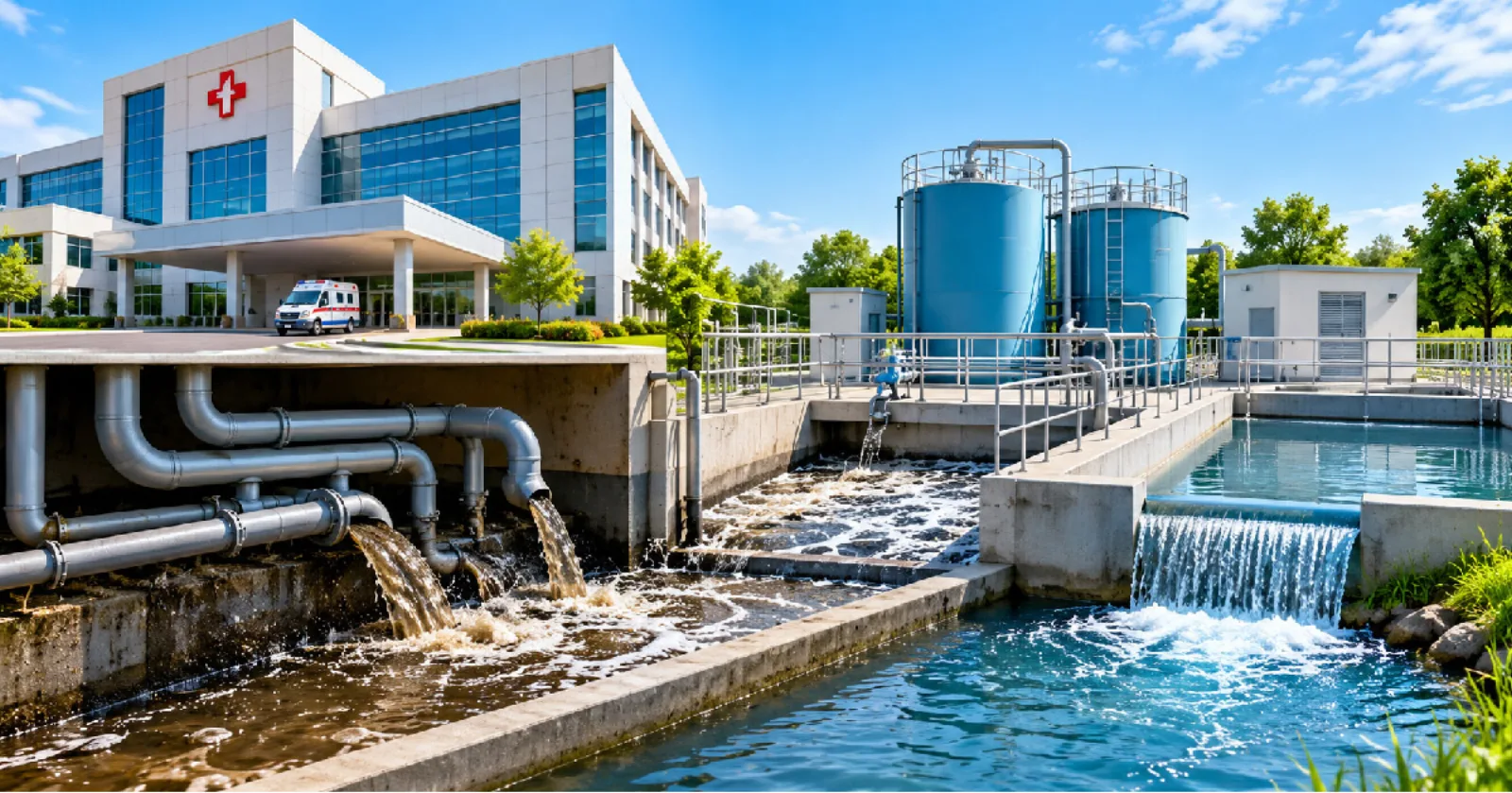
A hospital may look like any other large institutional building from the outside, but what leaves through its drains tells a very different story. Wastewater from laboratories, operation theatres, laundries, kitchens, wards and cleaning activities can carry organic matter, detergents, disinfectants, chemicals and other contaminants. Treating all of this like ordinary domestic sewage can create both environmental and operational problems.
That is why an effluent treatment plant should be viewed as part of a hospital's essential environmental infrastructure, not merely as equipment installed to meet a regulatory requirement.
The bigger question is not simply whether wastewater is being treated. It is whether the treatment system has been designed around what the hospital actually discharges, how flows change through the day and what quality of treated water is required at the outlet.
What Makes Hospital Wastewater Different?
Hospital wastewater is rarely uniform.
Residential structures generate wastewater mainly from toilets, bathrooms, and kitchens. Hospitals, on the other hand, add other sources of effluents with different characteristics. These include pathology labs, diagnostic departments, sterilization facilities, laundries, housekeeping units, kitchens, and different medical departments.
Consequently, effluents discharged from hospitals consist of suspended matter, organic substances, cleaning agents, disinfectants, and remnants of drugs and laboratory products.
The concentration of these substances may also change depending on the time of day.
This variability is one of the reasons why a standard treatment solution may not work and what is critical in wastewater management is to learn the source.
Indeed, the sewage profile of hospitals even of the same size (50 hospital beds vs multi-specialty hospitals with diagnostic centers, intensive care units, etc.) may be entirely different..
Why Hospitals Need an Effluent Treatment Plant
An effluent treatment plant for hospital applications performs a fairly straightforward job in principle: it receives contaminated wastewater, removes or reduces pollutants and produces treated water suitable for the intended discharge or reuse requirement.
What matters is how reliably it can do that when incoming wastewater conditions change.
1. Hospital wastewater can contain multiple pollutant types
A hospital's drains collect water from several activities at once. Laundry wastewater may contain detergents and suspended matter. Laboratory streams can introduce different chemical loads. Kitchen areas contribute fats and organic material, while sanitation and housekeeping operations add cleaning agents and disinfectants.
Trying to handle these streams without an appropriate treatment strategy can lead to unstable plant performance.
A properly engineered hospital wastewater treatment plant considers these variations before the treatment process is finalised.
2. Compliance cannot be treated as an occasional exercise
Wastewater discharge requirements are not something a hospital can address only when an inspection is due.
It is essential that the treatment installation is always operational. In India, wastewater discharge is controlled through environmental laws, standards and consent conditions of the State Pollution Control Boards/Committees. Requirements on a particular treatment procedure and discharge of treated wastewater are determined by parameters such as wastewater properties as well as geographical and specific characteristics of the site. Ion Exchange even states that industrial discharge facilities must be designed according to specific standards and consent conditions. That is why medical facilities require effluent treatment plants in order to ensure that treatment performed by these plants remains efficient over time.
How Does an Effluent Treatment Plant Work in a Hospital?
There is no single process train that suits every hospital.
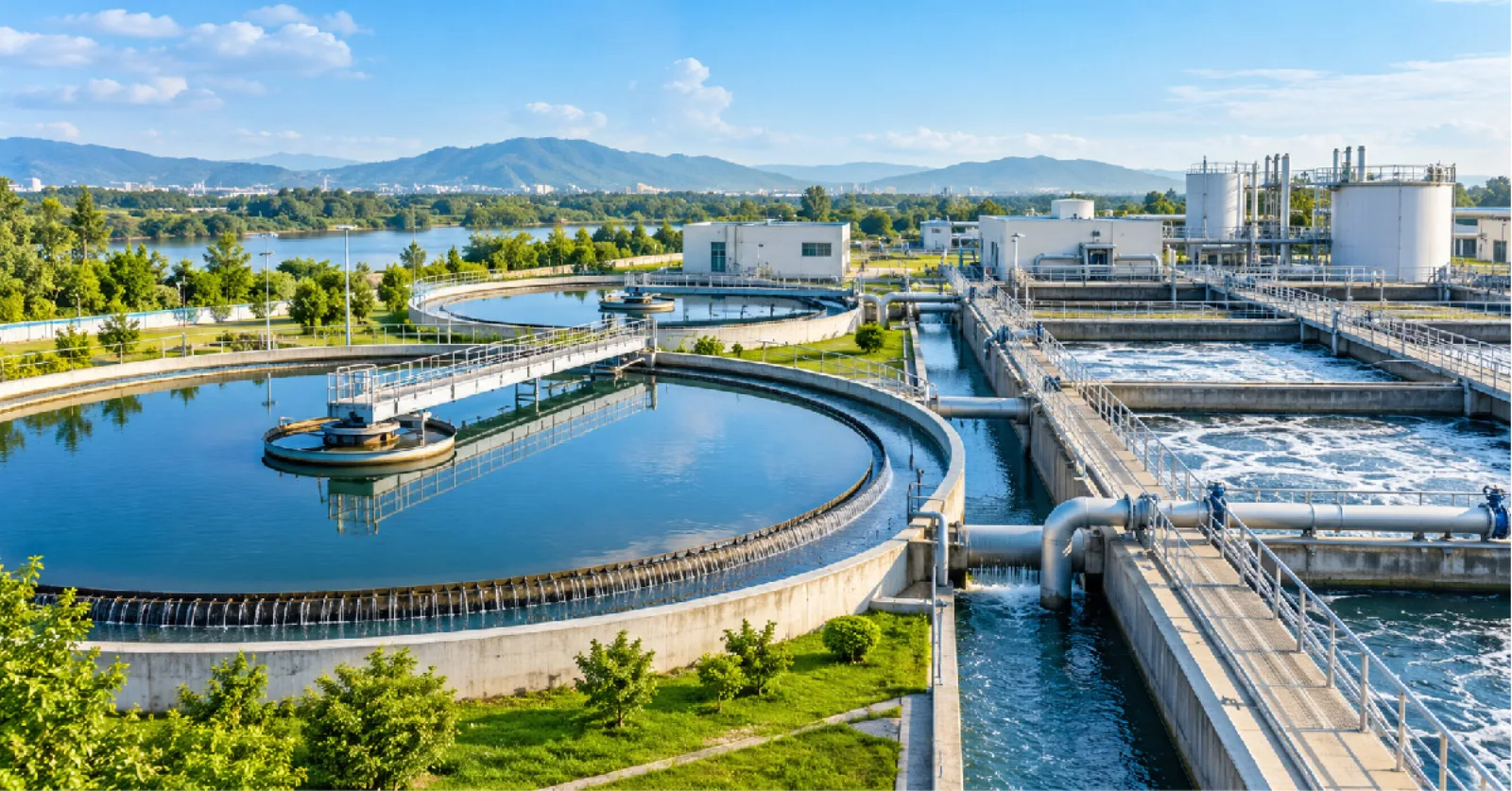
A typical effluent treatment plant may combine preliminary, physicochemical, biological and tertiary treatment depending on influent quality and the desired outlet standard. Advanced polishing can be added where greater water recovery or reuse is required.
Ion Exchange describes wastewater treatment as potentially including primary treatment, biological processes, tertiary treatment and recycling technologies, with advanced membrane or evaporation processes used where higher recovery is needed.
Preliminary and equalisation treatment
Screens can remove larger solids before wastewater enters downstream treatment equipment. An equalisation tank can then help balance changes in flow and contaminant concentration.
That balancing step deserves more attention than it often gets.
If wastewater arriving at the plant changes sharply from one hour to another, biological and chemical treatment stages can become difficult to operate efficiently. Equalisation gives the treatment process a more stable feed.
Physicochemical treatment
Depending on wastewater characteristics, treatment may include pH correction, coagulation, flocculation and clarification.
These processes can help reduce suspended matter and contaminants that are better removed before biological treatment.
Biological treatment
Biological processes use microorganisms to break down biodegradable organic contaminants.
The process selected should reflect the space available, wastewater load, operating requirements and desired treated-water quality. Simply choosing a technology because it is familiar is rarely the best engineering decision.
Tertiary treatment and disinfection
Where higher treated-water quality is required, tertiary treatment may include filtration, membrane processes and disinfection.
Ion Exchange defines tertiary treatment as the stage used to bring treated water to a higher level of refinement after primary and secondary treatment.
For hospitals considering reuse, this polishing stage can become particularly important.
Can Treated Hospital Wastewater Be Reused?
This is where wastewater management can shift from being purely a compliance expense to becoming part of a broader water-management strategy.
Depending on the quality achieved and applicable regulations, suitably treated water may potentially be considered for appropriate non-potable applications such as landscaping, flushing, cooling or other utility uses.
The opportunity matters because hospitals can have substantial and relatively continuous water demand.
Instead of approaching wastewater treatment only as a way of disposing of effluent, facility managers can ask a more useful question: How much of this water can safely and economically be brought back into use?
Ion Exchange's wastewater solutions focus on water recovery, reuse, reduced freshwater consumption and, where required, Zero Liquid Discharge.
The answer will differ from one hospital to another. Reuse should therefore be planned around treated-water quality, local requirements and the intended application rather than treated as a universal target.
What Hospitals Should Consider Before Selecting an ETP
Choosing an effluent treatment plant for hospital use based only on litres per day can be a costly mistake.
Start with wastewater characterisation.
Understand average and peak flows, pollutant loads, wastewater sources and expected variation. Check the available footprint. Define the required outlet quality. Decide whether treated water will only be discharged or whether reuse is part of the objective.
Operations matter too.
Who will run the system? How easy is it to monitor? What happens when wastewater loading suddenly increases? How will sludge be handled? Are critical components and service support readily available?
These questions may sound operational rather than strategic, but they determine whether a hospital wastewater treatment plant continues to perform after commissioning.
An efficient plant is not necessarily the one with the longest equipment list. It is the one designed around the realities of the facility.
Ion Exchange: An Integrated Approach to Hospital Wastewater Management
For hospitals, wastewater management is rarely an isolated engineering problem. It connects with freshwater availability, reuse targets, operational costs, environmental responsibilities and long-term facility planning.
Ion Exchange brings more than six decades of experience in Total Water and Environment Management Solutions, with capabilities spanning water treatment, wastewater treatment, recycling, membrane technologies and Zero Liquid Discharge systems.
Instead of following a simple approach of equipment purchasing for this project, Ion Exchange can consider the entire water cycle and plan suitable treatment methods taking into account the specific conditions of wastewater generated at the site.
The company’s full range of wastewater solutions includes preliminary treatment processes, biological treatment, tertiary treatment processes, and recycling techniques, which can be supported by membrane technologies and modern treatment systems when needed.
This comprehensive approach enables hospital managers and facility teams to solve the complex issue of reliable wastewater treatment with perspective of future recovery, recycling, and demand for water.
The Better Question Is: What Happens to Water After Use?
Hospitals invest heavily in systems that protect patients, staff and day-to-day operations. Wastewater deserves the same level of planning.
A well-designed effluent treatment plant helps a healthcare facility manage complex wastewater streams, support environmental compliance and create opportunities for responsible water reuse.
But the decision should begin with the wastewater, not with a catalogue of technologies.
Understand what the hospital discharges. Define the quality required at the other end. Then engineer the treatment system around that gap.
Planning a new hospital wastewater system or reviewing the performance of an existing one? Talk to Ion Exchange about a customised wastewater treatment and reuse solution designed around your facility's actual requirements.
Frequently Asked Questions
1. Why do hospitals need an effluent treatment plant?
Hospitals generate wastewater from laboratories, laundries, kitchens, wards, cleaning activities and other operations. Because these streams can contain different pollutants, an effluent treatment plant for hospital facilities helps reduce contaminants before wastewater is discharged or considered for appropriate reuse.
2. What is the difference between an ETP and an STP in a hospital?
An STP primarily treats domestic sewage from toilets, kitchens and similar facilities. An ETP is designed to handle process-related effluent that may contain chemicals, organic loads, suspended solids or other contaminants. Some hospitals may require both systems depending on wastewater sources and local requirements.
3. What contaminants are commonly found in hospital wastewater?
Hospital wastewater can contain organic matter, suspended solids, detergents, disinfectants, cleaning chemicals and traces of substances associated with laboratory or healthcare activities. The exact composition varies significantly between hospitals, which is why wastewater characterisation is important before treatment-system design.
4. Can treated hospital wastewater be reused?
Yes, depending on the treatment achieved, intended application and applicable regulations. Properly treated wastewater may be evaluated for suitable non-potable uses such as landscaping, flushing or selected utility applications. The appropriate reuse strategy should be determined during system design.
5. How is the right hospital wastewater treatment system selected?
Selection should consider wastewater quantity and quality, daily flow variations, available space, discharge standards, reuse objectives, operating manpower and lifecycle cost. A detailed wastewater assessment is usually a better starting point than selecting a plant purely on capacity.