Water recovery and reuse
Recover additional water from saline streams for suitable industrial applications, reducing freshwater intake and the volume requiring further treatment.
Brine contains more than dissolved salts. It holds opportunities for water recovery, raw material reuse and valuable product recovery.
At Ion Exchange (India) Limited, we bring together membrane technologies, ion exchange resins and integrated process engineering to help customers evaluate and unlock this potential. Our approach connects advanced brine management with resource recovery, helping reduce freshwater demand, minimizing residual waste and improving resource efficiency.
Desalination plants, industrial wastewater treatment systems, mining operations and chemical manufacturing processes generate saline streams with widely differing compositions.
High salinity, scaling potential, complex impurities and variable feed quality create challenges in brine treatment. At the same time, the dissolved constituents offer opportunities to recover valuable resources including lithium for batteries and energy storage, magnesium for industrial applications, and sodium chloride as a feedstock for disinfectant and chlor-alkali production. Other opportunities include potassium salts for fertilizers and bromine for specialty chemicals. We offer Integrated separation and purification to help convert these streams into reusable water and useful raw materials, with recovery pathways selected according to resource concentration, product quality requirements and economic viability.
Brine-based industries, particularly critical metal extraction (e.g., lithium and other valuable metals), often operate in water-scarce regions where low water recovery and recycling rates increase pressure on freshwater resources. Excessive extraction of groundwater and brine can disrupt the natural hydrological balance, creating long-term environmental and operational challenges. Improving water recovery, recycling, and sustainable water management is therefore critical to ensuring sustainable mining and responsible brine valorization.
Recover additional water from saline streams for suitable industrial applications, reducing freshwater intake and the volume requiring further treatment.
Recover and purify salts such as Sodium Chloride (NaCl) and Sodium Sulphate (Na₂SO₄) for suitable process applications, subject to feed composition and product specifications.
Convert suitably treated sodium chloride brine into sodium hypochlorite through electrochlorination, creating a useful disinfectant (Cl₂, OCl-, HOCl) for water treatment and industrial applications.
Recover and condition sodium chloride brine for on-site disinfectant production.
Combining membranes and selective resin-driven solutions to recover magnesium, calcium, etc.
Valuable elements such as Li, Mg, K and Br can be recovered depending on brine composition, chemistry and the selected process route.
Following appropriate separation, purification and concentration adjustment, a suitable NaCl-rich stream can serve as feedstock for electrochlorination. Use our electrochlorination systems to convert the salt solution into Sodium Hypochlorite for disinfection.
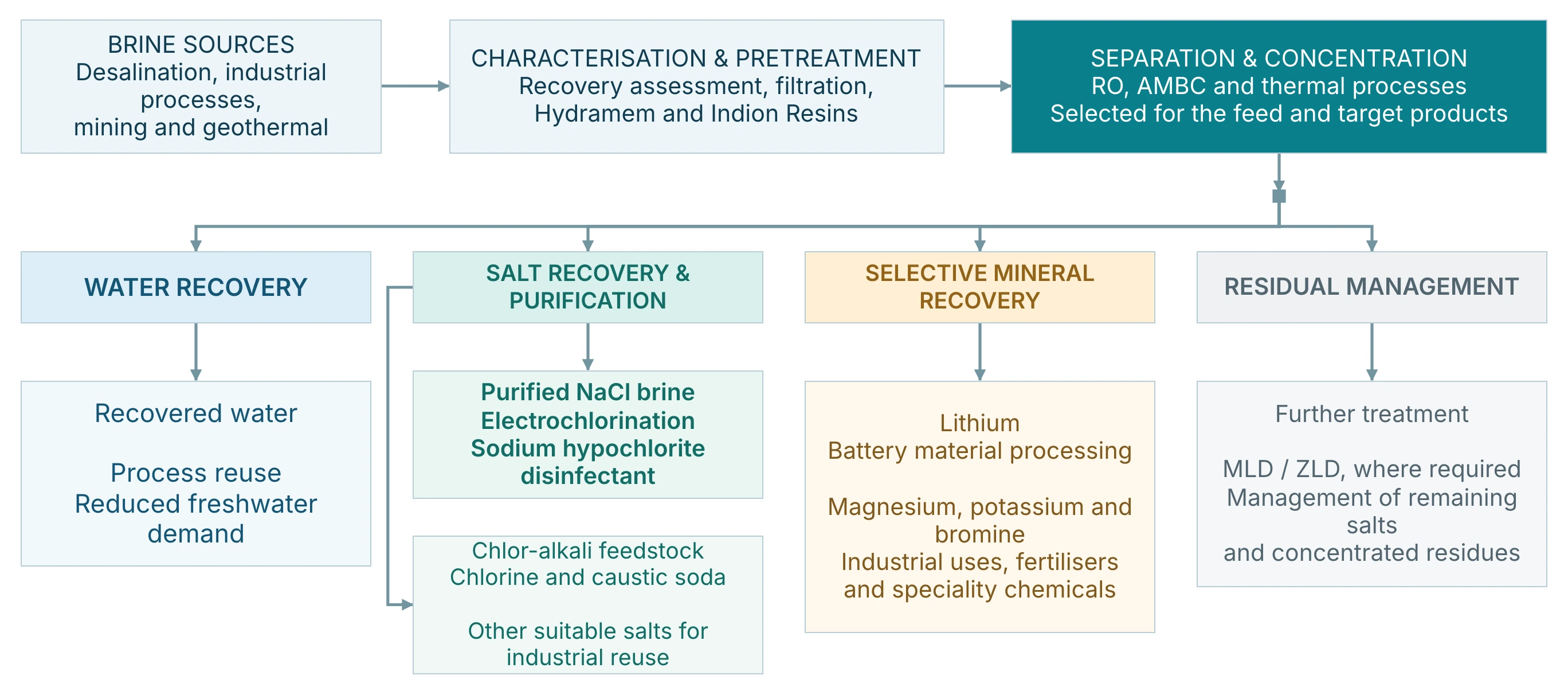
The pathways below illustrate how an integrated approach can connect different brine sources with applications in industrial reuse, disinfection, chemical production and battery materials.
Our core technologies and capabilities include:
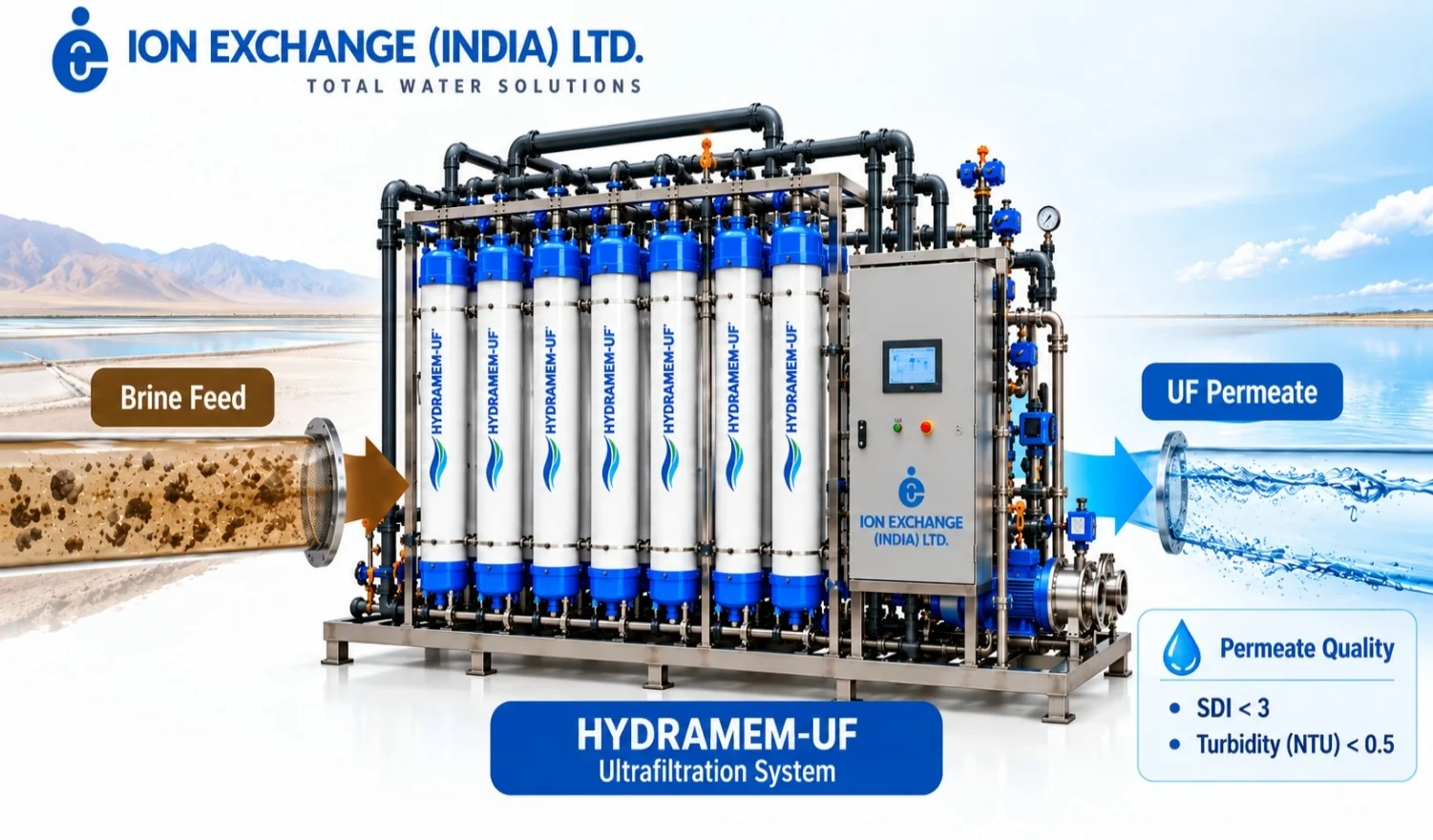
Pretreatment and suspended solids removal.
Explore membranes →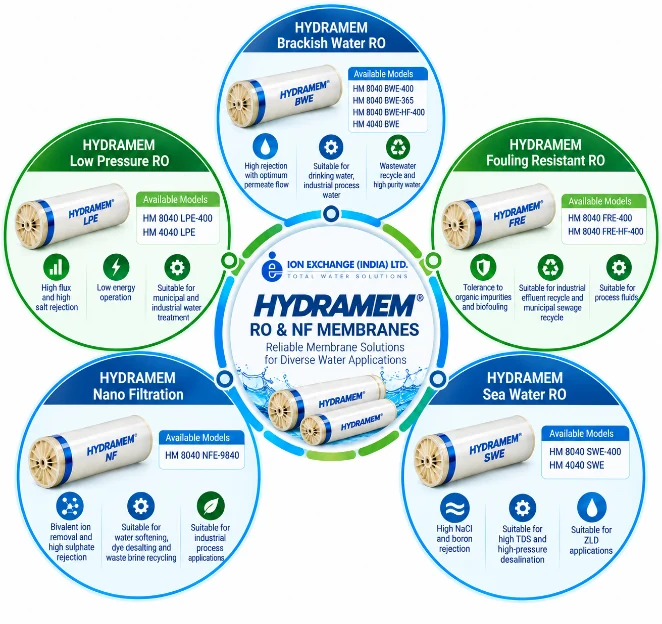
Selective separation and water recovery, according to feed chemistry.
Explore membranes →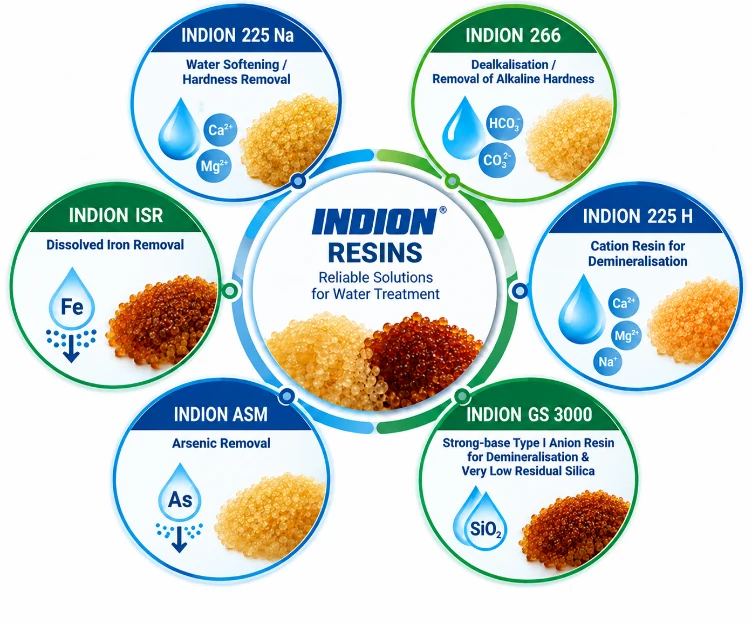
Targeted impurity removal and polishing.
Explore ion exchange resins →Further water recovery and brine concentration within the applicable operating envelope.
Integration of evaporation and crystallization as needed.
Integration with desalination, wastewater treatment, recycling and residual stream management.
Membrane and thermal processes can be combined to suit the required recovery, concentration and final product quality.
| INDION resin family | Chemistry | Brine-valorization role |
|---|---|---|
| BSRM | ChemistryAminophosphonic + iminodiacetic chelating resin | Brine-valorization roleCa/Mg polishing of concentrated brine; DLE pre-treatment; chlor-alkali brine purification |
| BSR | ChemistryAminophosphonic chelating resin | Brine-valorization roleDecalcification / hardness removal from brines |
| SIR | ChemistryIminodiacetic chelating resin | Brine-valorization roleSelective removal/recovery of divalent and transition metals from brines/process liquors |
| MSR | ChemistryThiol chelating resin | Brine-valorization roleSelective Hg²⁺ removal from contaminated industrial/mineral brines |
| TCR | ChemistryThiouronium resin | Brine-valorization roleMercury + precious-metal recovery from suitable high-salinity process streams |
| 790 | ChemistryMacroporous SAC | Brine-valorization roleMetal recovery / scavenging from aqueous streams; possible pre/post-polishing |
| 730 | ChemistryMacroporous SAC | Brine-valorization roleMetal recovery from aqueous/non-aqueous streams. For processes like converting di-sodium tartrate dihydrate to tartaric acid |
| 740 | ChemistryMacroporous SAC | Brine-valorization roleMetal recovery from aqueous/non-aqueous streams |
| 236 | ChemistryPolyacrylic WAC | Brine-valorization roleDivalent-metal removal / recovery under suitable pH conditions |
| 652 / 662 | ChemistryMethacrylic WAC | Brine-valorization roleCa/Mg or divalent-metal scavenging from concentrated streams |
| SBA/WBA | ChemistryGeneral anion exchange | Brine-valorization roleFinal anionic-impurity polishing after upstream separation |
A successful brine valorization project starts with the intended use of the recovered resource.
We work with you to assess brine composition, recovery potential, product specifications, site utilities and reuse or offtake opportunities. Laboratory evaluation and pilot-scale testing help establish an appropriate flowsheet and assess technical and economic feasibility.
Our areas of focus include selective mineral recovery and integration with downstream chemical conversion processes, supported by in-house R&D and strategic partnerships.
Whether your priority is recovering more water, reusing salt or developing a resource recovery solution, and sustainable water management, Ion Exchange can help you execute the next step.