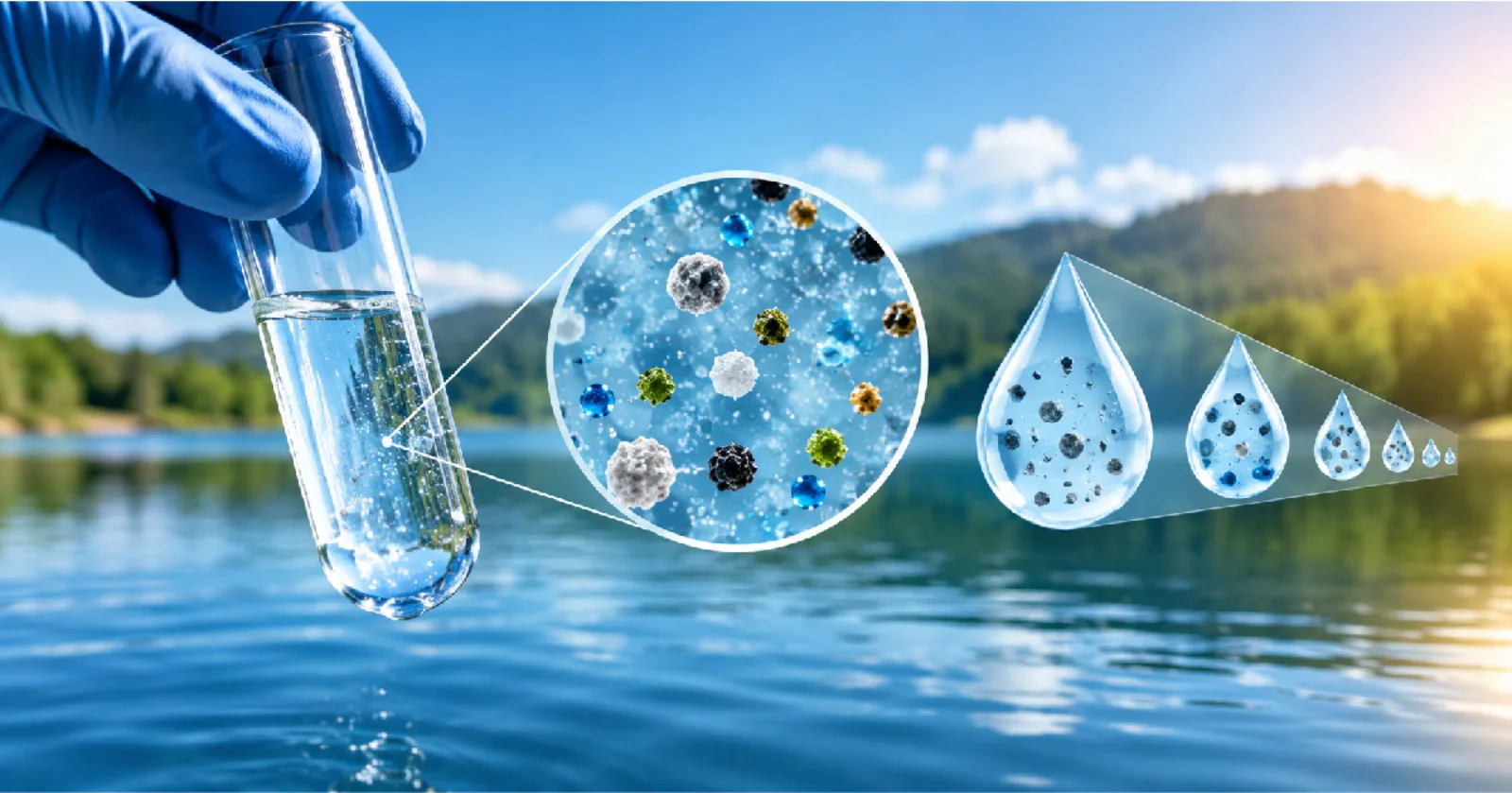
Water quality is often measured by the concentration of dissolved substances, chemicals, minerals, or contaminants present in a given volume of water. One commonly used unit for expressing very small concentrations is PPM, or parts per million.
Understanding parts per million, its calculation, and how PPM is used in water treatment helps operators interpret water-quality test results and determine appropriate treatment requirements.
What Is PPM (Parts Per Million)?
PPM stands for parts per million. It represents one part of a substance present in one million parts of the total solution or mixture.
In simple terms:
1 PPM = 1 part of a substance in 1,000,000 parts of the solution
For dilute water-based solutions, 1 PPM is approximately equivalent to 1 mg/L (milligram per litre).
For example, if water contains 5 mg of dissolved iron in one litre of water, its concentration is approximately 5 PPM.
What Does PPM Measure?
PPM is used to express the concentration of substances present in very small quantities.
In water treatment, PPM can be used to measure:
- Dissolved salts
- Chlorine
- Hardness
- Iron
- Fluoride
- Nitrate
- Chemicals
- Other contaminants
The parameter being measured and the testing method determine how the PPM value should be interpreted.
What Is the PPM Formula?
The basic PPM formula is:
PPM = (Amount of substance ÷ Total amount of solution) × 1,000,000
For mass-based measurements, the formula can be written as:
PPM = (Mass of solute ÷ Mass of solution) × 1,000,000
For dilute water solutions, concentration is commonly expressed as:
PPM ≈ mg/L
This approximation is widely used because the density of dilute water is close to 1 kg/L.
How to Calculate PPM?
Consider a solution containing 10 mg of a dissolved substance in 1 litre of water.
Using the approximate water-treatment relationship:
10 mg/L ≈ 10 PPM
Therefore, the concentration is approximately 10 PPM.
For a mass-based calculation, if 2 grams of a substance are present in 1,000,000 grams of solution:
PPM = (2 ÷ 1,000,000) × 1,000,000
PPM = 2
So, the concentration is 2 PPM.
PPM in Water Treatment
PPM is particularly useful in water treatment because many water-quality parameters occur at relatively low concentrations.
For example, treatment operators may monitor PPM levels of:
Chlorine
Chlorine concentration can be monitored to maintain appropriate disinfection performance.
Hardness
Calcium and magnesium concentrations can contribute to water hardness and scaling.
Iron
Elevated iron can affect water appearance, taste, and downstream treatment processes.
Fluoride and Nitrate
These dissolved constituents may need to be monitored depending on the source water and intended application.
Total Dissolved Solids
TDS is commonly expressed in mg/L and is often approximately represented as PPM in dilute water.
PPM vs Percentage: What Is the Difference?
PPM and percentage both express concentration, but they represent very different scales.
1% = 10,000 PPM
Therefore:
- 1% = 10,000 PPM
- 0.1% = 1,000 PPM
- 0.01% = 100 PPM
- 0.001% = 10 PPM
PPM is therefore useful when the concentration of a substance is too small to conveniently express as a percentage.
Why Is PPM Important in Water Treatment?
PPM measurements help treatment operators understand water quality and control treatment processes.
Monitoring PPM can help with:
Treatment Control
Chemical dosing can be adjusted according to measured contaminant or chemical concentrations.
Water Quality Monitoring
Changes in PPM can indicate changes in source-water quality or treatment performance.
Equipment Protection
Monitoring parameters such as hardness, silica, iron, and dissolved salts can help manage scaling and fouling risks.
Process Control
Industrial processes often require water within specific quality ranges, making accurate concentration measurement important.
How Is PPM Measured?
The measurement method depends on the parameter being tested.
Water-quality laboratories can use analytical methods to determine the concentration of specific substances. Portable instruments and test kits can also be used for certain parameters.
For example, TDS meters commonly estimate dissolved-solids concentration from electrical conductivity and display the result in a value commonly interpreted as PPM.
The measurement should always be interpreted according to the parameter, testing method, and application.
PPM and Industrial Water Treatment
Industrial facilities monitor different parameters in PPM depending on their water-quality requirements.
For example:
- Boiler systems: hardness, silica, phosphate, and dissolved solids
- Cooling systems: hardness, chemicals, dissolved solids, and corrosion-control parameters
- RO systems: feed-water TDS, permeate TDS, and concentrate quality
- High-purity water systems: specific ionic and dissolved contaminants
The acceptable PPM level is therefore not the same for every application. It depends on the process and the required water quality.
Ion Exchange Solutions for Water Quality Management
Ion Exchange provides integrated water treatment solutions designed to control dissolved contaminants and maintain water quality across industrial and specialised applications.
Its technologies include:
- Ion exchange
- Water softening
- Demineralisation
- Reverse osmosis
- Ultrafiltration
- Nanofiltration
- Filtration
- Disinfection
Ion exchange resins can selectively remove or exchange specific ions, while RO and other membrane technologies can reduce dissolved salts and contaminants across broader water-treatment applications.
The right treatment technology depends on the contaminant being measured, its concentration, source-water characteristics, and the required treated-water quality.
How to Use PPM Results for Water Treatment Decisions?
A PPM reading by itself does not determine which treatment technology should be used.
A proper treatment assessment should consider:
- Identify the parameter: Determine exactly what the PPM value represents.
- Analyse the source water: Evaluate other water-quality parameters that may affect treatment.
- Define the required output: Establish the water quality required for the intended application.
- Select the appropriate technology: Choose filtration, ion exchange, RO, or another treatment process based on the contaminants present.
- Monitor performance: Regular testing helps confirm that the treatment system is achieving the required water quality.
Conclusion
PPM (parts per million) is a useful way to express very small concentrations of substances in water and other solutions. In dilute water-based applications, PPM is commonly used interchangeably with mg/L as an approximate concentration measure.
Understanding the PPM formula and correctly interpreting PPM results can help industries monitor water quality, manage chemical dosing, protect equipment, and select appropriate treatment technologies.
Ion Exchange provides integrated water-treatment technologies for controlling dissolved contaminants and achieving application-specific water-quality requirements.
Connect with Ion Exchange experts to assess your water quality and identify the right treatment solution for your application.
FAQs
What does PPM stand for?
PPM stands for parts per million and represents one part of a substance in one million parts of a solution or mixture.
How do you calculate PPM?
The basic formula is PPM = (amount of substance ÷ total amount of solution) × 1,000,000.
Is 1 PPM equal to 1 mg/L?
For dilute water-based solutions, 1 PPM is approximately equal to 1 mg/L because the density of water is close to 1 kg/L.
What is PPM used for in water treatment?
PPM is used to express concentrations of parameters such as chlorine, hardness, iron, fluoride, nitrate, dissolved salts, and other water-quality constituents.
Why is PPM important for industrial water treatment?
PPM measurements help monitor water quality, control chemical dosing, assess treatment performance, and manage contaminants that can affect industrial processes and equipment.