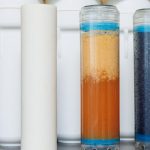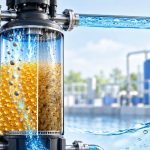


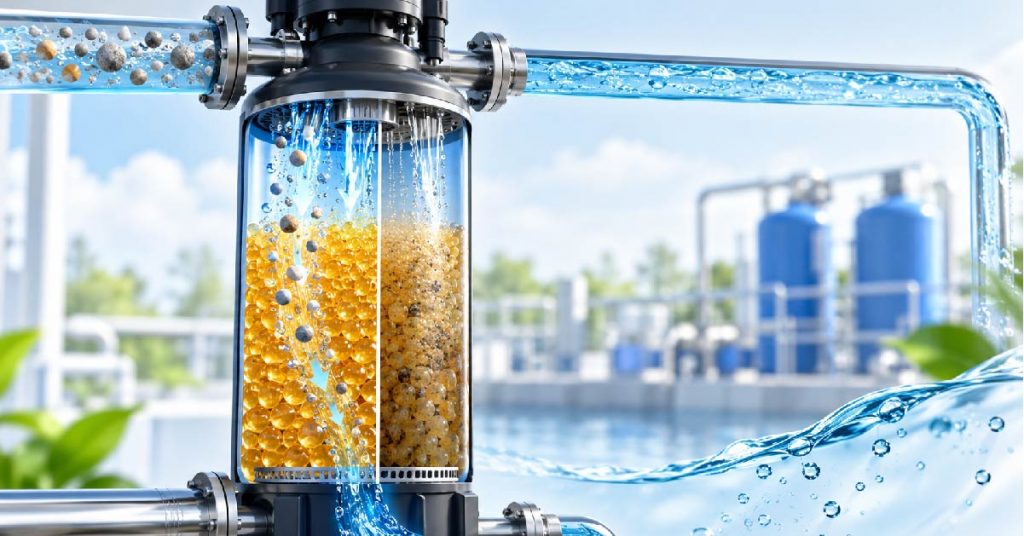
A water softener may look like a fairly simple piece of treatment equipment, but the real work happens inside the resin bed. That is where hardness-causing calcium and magnesium ions are captured before they can move downstream and create scale.
Thus, Water Softener Resin is much more than a mere consumable residing inside a pressure vessel. Its condition has a direct bearing on softened-water quality, regeneration frequency, salt usage, and, in the case of industrial systems, the consistency of the downstream processes.
This poses a problem as resin seldom fails suddenly. Its performance typically declines gradually. The system may start generating more often, the leakage of hardness may increase, or the pressure drop may arise slowly. Being aware of the resin’s performance and the meaning of the early symptoms of failure allow for making better their replacements.
Table of Contents
ToggleHow Does Water Softener Resin Work?
Most conventional softeners use a strong acid cation exchange resin in the sodium form. The resin consists of small polymer beads containing negatively charged functional sites that temporarily hold sodium ions.
When hard water passes through the bed, calcium and magnesium have a stronger attraction to these sites than sodium. They are therefore retained by the resin, while sodium is released into the treated water.
In simple terms:
Calcium and magnesium enter the resin bed → the resin captures them → sodium is released → softened water leaves the unit.
The operational principle of an ion exchange resin in the case of water softeners is that hard water treatment is possible till the resin bed gets exhausted.
The exhaustion of the resin bed can happen over time as it gets accumulated with hardness ions. The only way to restore the resin is to use concentrated sodium chloride solution.
During the regeneration process, high sodium concentration changes the situation and removes the hardness ions from the resin bed.
The process of restoring ion exchange resin is important and allows for successful completion of many cycles of hard water treatment.
Why Cation Exchange Resin Is Used for Softening
The softening process relies on the selective removal of hardness ions that have positive charge. This is the principal function of a cation exchange resin.
An example of a cation resin used in the softening process is INDION 2250 Na manufactured by Ion Exchange. It is supplied in sodium form and appears as a strongly acid cross-linked polystyrene cation resin. The methodology used in this resin application indicates that sodium chloride is the regenerant used.
Another example of a strong acid resin is INDION CST which can be supplied as sodium resin or hydrogen resin. Ion Exchange indicates that this resin can be used as sodium form sodium for softening water purpose.
The last two example should be taken into consideration while using cation exchange resin in the softener applications. The choice of resin should depend on the water quality, quantity, hydraulic conditions, regeneration procedure and expected contamination level.
What Determines Water Softener Resin Lifespan?
There is no single universal number for water softener resin lifespan.
A properly selected and operated resin can be regenerated and reused for many years. But actual life depends less on calendar age than on what the resin has experienced while in service.
Feed-water quality
Iron, impurities, organic matter and other kinds of material can clog and coat the resin beads. Although resin might still be physically present in the container, the usable capacity drops significantly.
Chemical agents can damage polymers over time. Among other drawbacks, Ion Exchange’s troubleshooting instructions specifically refer to oxidative damage and heavy metals like iron.
Regeneration quality
A resin bed may appear to be losing capacity when the real issue is poor regeneration.
Incorrect regenerant quantity, concentration, contact conditions or rinse flow can reduce performance between regeneration cycles. Channeling inside the bed can create similar symptoms because part of the resin is effectively bypassed.
This is why water softener resin replacement should not be the first reaction every time hardness begins to leak through.
Mechanical condition
Resin beads are exposed to repeated hydraulic movement, backwashing and chemical cycling. Over time, damaged beads and excessive fines may increase pressure drop or interfere with uniform flow through the bed.
When operators see declining output, the useful question is not simply, “How old is the resin?” It is, “Has its usable exchange capacity materially changed?”
Five Signs the Resin May Need Replacement
Several operating symptoms deserve closer attention.
1. Hardness appears earlier in the service cycle
If treated-water hardness begins increasing well before the normal regeneration point, available exchange capacity may have fallen.
2. Regeneration becomes increasingly frequent
A system that once delivered an acceptable throughput between regenerations but now needs far shorter cycles deserves investigation. Increased ionic loading should be ruled out first, because harder influent water naturally shortens the run.
3. Treated-water quality remains poor after correct regeneration
If regeneration conditions, brine concentration, flow rates and equipment internals have been checked but performance remains weak, deteriorated resin becomes more likely.
Ion Exchange recommends resin sampling and analysis where deterioration is suspected rather than relying only on visual judgement.
4. Pressure drop keeps rising
Excessive fines, a dirty bed, precipitation or collector problems can all increase pressure drop. This does not automatically mean the resin must be replaced, but persistent hydraulic problems warrant inspection.
5. Cleaning restores little or no capacity
Some fouling problems can be corrected through appropriate resin cleaning. If properly diagnosed cleaning and regeneration fail to restore acceptable performance, water softener resin replacement may become economically preferable to continued operation at reduced capacity.
Replace the Resin or Fix the System?
One of the easiest maintenance mistakes is replacing resin before diagnosing the cause of poor performance.
Suppose a softener suddenly delivers less treated water between regenerations. The resin may indeed be exhausted or degraded. But the same symptom can result from increased feed hardness, insufficient regenerant, dirty resin, channeling or changes in water characteristics. Ion Exchange lists all of these among possible causes of low output between regenerations.
A better approach is to compare current operation against a known baseline: inlet hardness, outlet hardness, throughput per cycle, brine consumption, pressure drop and regeneration conditions.
Trends usually tell the story better than age alone.
Choosing the Right Resin for Reliable Softening
It is essential to assure that the desired water softening resin is not merely a standard type but matches the specific application.
Ion Exchange manufactures INDION ion exchange resins that include a wide range of products including gel types, macroporous resins and isoporous resins, for treating water and waste water as well as various specialist applications. The manufacturing plant located in Ankleshwar is engaged in research and development of technology and processes for the production of different types of resins.
The knowledge of chemicals and other applications of the products may assist the engineers and operators in using INDION resins in the most efficient way.
Final Thoughts
Water Softener Resin performs a deceptively simple job: exchanging hardness ions for sodium. Yet its long-term performance depends on resin chemistry, feed-water quality, hydraulic design and disciplined regeneration.
Instead of depending on a certain number of years to determine the need for replacement, monitor the actual behavior of the resin. Ongoing leakage of hardness, shortening of the service run, continuing pressure drop and insufficient capacity after proper regeneration are far better criteria.
If the performance of water quality in your softening system is important for your business, Ion Resins has the INDION services and systems of ion exchange technology to assist you in selecting the appropriate resin for your water treatment needs.
Contact Ion Resins to choose the appropriate resin grade for your needs or to check if your current resin is still performing as it should.